
 By
By 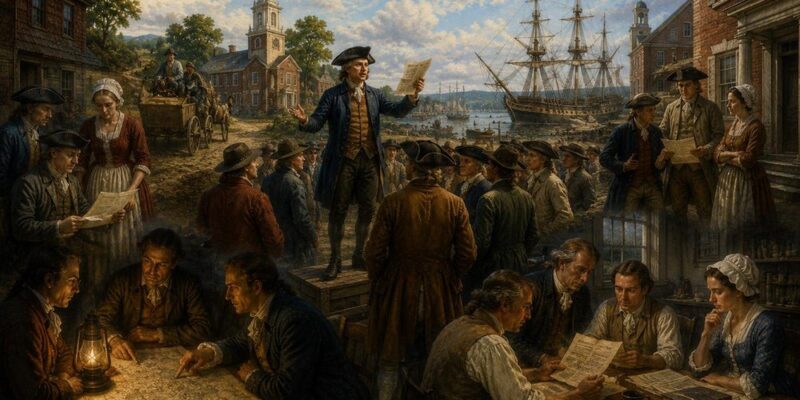
The Communication Networks, Influential Thinkers, and Grassroots Efforts That Fueled American Independence.
The American Revolution was not only a military conflict fought on battlefields; it was also a revolution of ideas. Before the Declaration of Independence was signed and before the Continental Army secured victory against Great Britain, a powerful transformation occurred within the minds of many colonists. Concepts involving liberty, self-government, natural rights, and resistance to tyranny gradually spread throughout the thirteen colonies, encouraging ordinary people to reconsider their relationship with British rule.
Unlike modern societies connected by digital technology and instant communication, colonial America relied on newspapers, pamphlets, public gatherings, sermons, letters, and personal conversations to exchange information. Despite these limitations, revolutionary ideas traveled remarkably quickly, influencing individuals from diverse backgrounds and helping create a shared sense of purpose among communities separated by geography and local interests.
Understanding how revolutionary ideas spread across the colonies reveals that the American Revolution was not inevitable. Rather, it emerged through persuasion, debate, and the active participation of people who communicated new political philosophies and encouraged others to support independence. The spread of these ideas helped transform scattered dissatisfaction into a unified movement that ultimately reshaped world history.
“The American Revolution succeeded not simply because colonists fought for independence, but because they first embraced the ideas that made independence seem both necessary and possible.”
Enlightenment Philosophy and the Origins of Revolutionary Thought
Many of the ideas that inspired the American Revolution originated during the Enlightenment, an intellectual movement that emphasized reason, individual rights, and challenges to traditional authority.
European philosophers questioned longstanding assumptions about government and explored concepts that would profoundly influence colonial leaders.
Among the most important thinkers was John Locke.
Locke argued that:
- Individuals possess natural rights.
- Governments exist to protect those rights.
- Political authority derives from the consent of the governed.
- Citizens have the right to alter or replace governments that violate their rights.
Other influential Enlightenment figures included:
- Baron de Montesquieu
- Jean-Jacques Rousseau
- Voltaire
Colonial intellectuals and political leaders incorporated these principles into discussions about taxation, representation, and British authority.
The widespread appeal of Enlightenment philosophy provided colonists with a framework for understanding their grievances not merely as local disputes but as broader questions concerning liberty and legitimate government.
Newspapers Became Powerful Tools of Communication
Newspapers played a critical role in spreading revolutionary ideas throughout the colonies.
By the 1770s, dozens of colonial newspapers circulated political news, essays, speeches, and commentary addressing relationships between Britain and the colonies.
Newspapers helped colonists:
- Learn about events occurring in other colonies.
- Share political arguments.
- Debate government policies.
- Promote resistance efforts.
- Develop a common understanding of British actions.
Editors frequently reprinted articles from other publications, allowing ideas to spread far beyond their original audiences.
Coverage of major events-including:
- The Stamp Act
- The Boston Massacre
- The Boston Tea Party
- The Intolerable Acts
helped generate widespread awareness and emotional responses.
Political cartoons and illustrations also influenced public opinion by presenting complex issues in accessible ways.
Although newspapers reflected varying viewpoints, Patriot leaders effectively used them to encourage support for colonial rights and eventual independence.
Pamphlets Simplified Complex Political Ideas
Among the most influential communication tools of the revolutionary period were pamphlets.
Pamphlets were inexpensive, widely distributed publications that addressed political topics in clear, persuasive language accessible to ordinary readers.
One of the most famous examples was Common Sense by Thomas Paine, published in January 1776.
This influential work argued that:
- Monarchy was fundamentally flawed.
- British rule no longer served colonial interests.
- Independence represented a practical and necessary solution.
- Americans possessed both the right and the ability to govern themselves.
Paine wrote in straightforward language rather than academic prose, allowing his arguments to reach broad audiences.
Common Sense became one of the best-selling publications of its era and significantly increased support for independence.
Other pamphlets addressed topics such as:
- Taxation without representation
- Constitutional rights
- Colonial grievances
- Economic concerns
- Military developments
Pamphlets encouraged widespread political engagement and fostered informed public debate.
“Pamphlets transformed abstract political philosophy into persuasive arguments that ordinary colonists could understand and support.”
Public Gatherings Encouraged Political Participation
Face-to-face communication remained essential during the colonial period.
Public meetings and local gatherings provided opportunities for colonists to exchange ideas and discuss political developments.
Common venues included:
Town Meetings
Especially prevalent in New England, town meetings allowed citizens to debate issues affecting their communities.
Taverns
Taverns served as important centers for social interaction and political discussion.
People gathered to:
- Share news
- Debate policies
- Organize resistance efforts
- Coordinate local activities
Committees of Correspondence
These organizations facilitated communication between colonies by exchanging letters and reports regarding British actions.
Committees helped:
- Disseminate information rapidly
- Coordinate responses
- Promote unity among colonies
Provincial Congresses and Assemblies
Political leaders collaborated to address shared concerns and develop collective strategies.
These gatherings encouraged civic participation and strengthened networks supporting revolutionary efforts.
Personal interactions often reinforced ideas encountered through newspapers and pamphlets.
Religious Leaders and Sermons Influenced Public Opinion
Religion played an important role in colonial life, and many ministers used sermons to address contemporary political issues.
Some clergy interpreted conflicts with Britain through moral and religious frameworks, emphasizing themes such as:
- Justice
- Liberty
- Responsibility
- Resistance to oppression
Patriot ministers sometimes argued that defending colonial rights aligned with religious principles.
Sermons reached diverse audiences and offered another avenue for discussing political ideas.
Religious gatherings provided opportunities for:
- Community reflection
- Dissemination of information
- Reinforcement of shared values
However, not all religious leaders supported independence.
Some remained loyal to Britain or encouraged neutrality.
Nevertheless, religious institutions contributed significantly to public discourse during the revolutionary era.
Personal Networks and Word-of-Mouth Communication
In an age before electronic communication, personal relationships played an essential role in spreading revolutionary ideas.
Information frequently traveled through:
- Family connections
- Friendships
- Business relationships
- Postal correspondence
- Travelers moving between colonies
Merchants, artisans, sailors, and political leaders exchanged information across extensive networks.
Letters between influential figures helped shape strategy and coordinate resistance efforts.
Word-of-mouth communication also allowed individuals who could not easily access newspapers or pamphlets to remain informed.
Community conversations often influenced opinions by:
- Clarifying political developments
- Reinforcing local sentiments
- Encouraging participation in collective actions
These informal networks complemented formal communication channels and expanded the reach of revolutionary ideas.
Creating a Shared American Identity
Before the Revolution, many colonists identified primarily with their individual colonies rather than viewing themselves as Americans.
The spread of revolutionary ideas helped foster a broader sense of shared identity.
Colonists increasingly recognized common concerns involving the following:
- Representation
- Taxation
- Political rights
- Economic interests
- Resistance to perceived tyranny
Shared experiences and communication networks contributed to the development of unity across geographic boundaries.
This emerging American identity proved essential because successful resistance required cooperation among colonies with differing economies, cultures, and priorities.
The ability to build consensus around revolutionary principles strengthened the movement for independence and laid foundations for future national development.
Frequently Asked Questions
How did revolutionary ideas spread throughout the colonies?
Ideas spread through newspapers, pamphlets, public meetings, sermons, committees of correspondence, and personal communication networks.
Why was Common Sense important?
Common Sense presented persuasive arguments supporting independence in language accessible to ordinary colonists, significantly increasing support for separation from Britain.
What role did newspapers play during the American Revolution?
Newspapers shared political information, reported events, encouraged debate, and helped create a sense of unity among the colonies.
How did Enlightenment ideas influence the Revolution?
Enlightenment philosophers promoted concepts such as natural rights, government by consent, and resistance to tyranny, which shaped revolutionary thinking.
Why were committees of correspondence important?
They facilitated communication between colonies, coordinated responses to British actions, and strengthened cooperation among Patriot leaders.






Comments